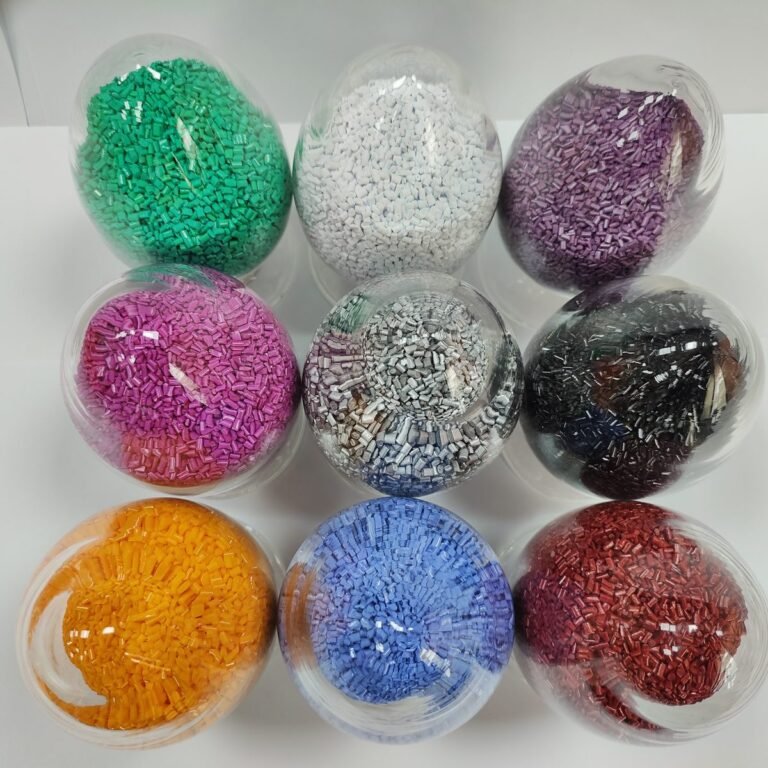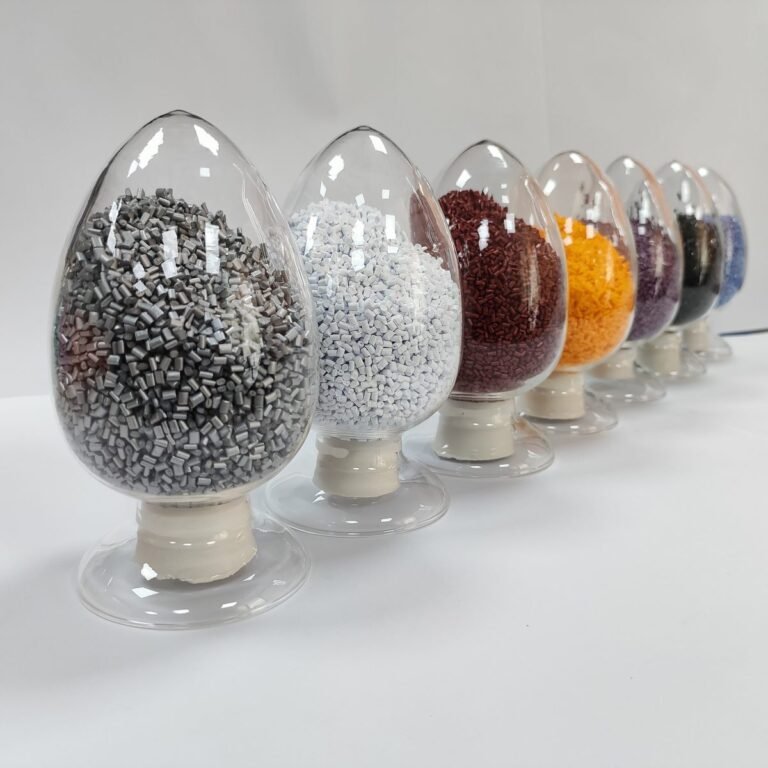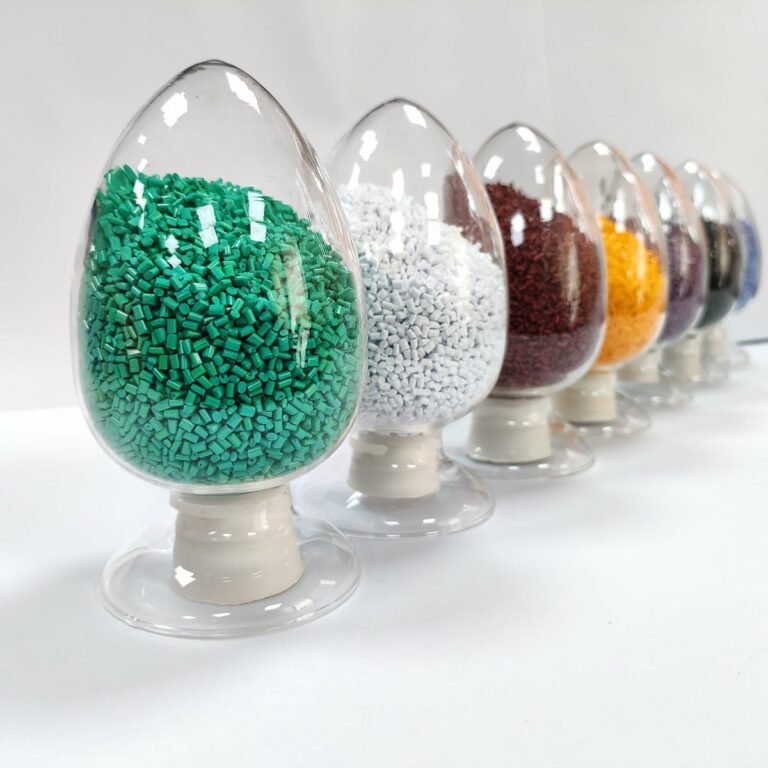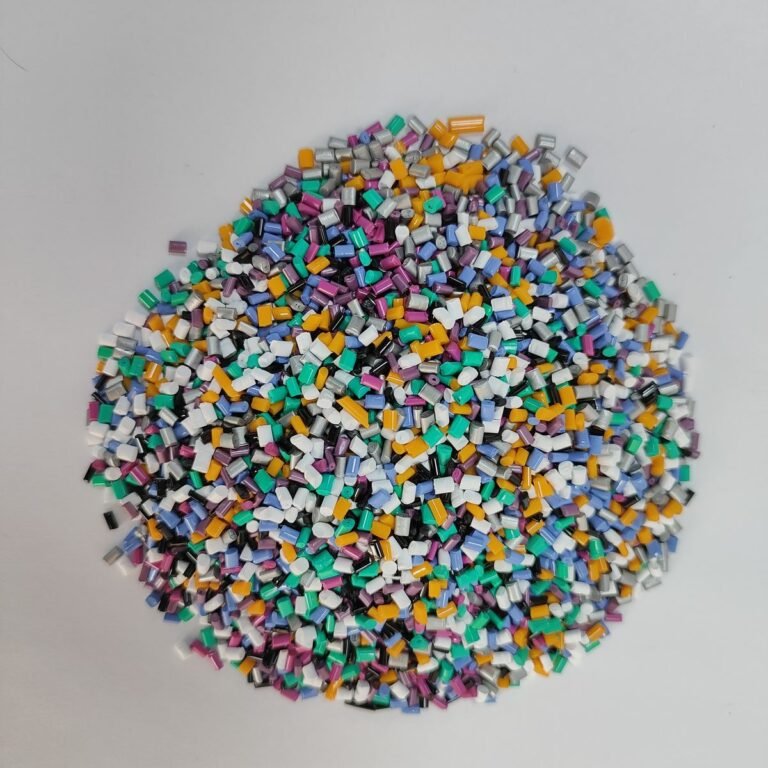


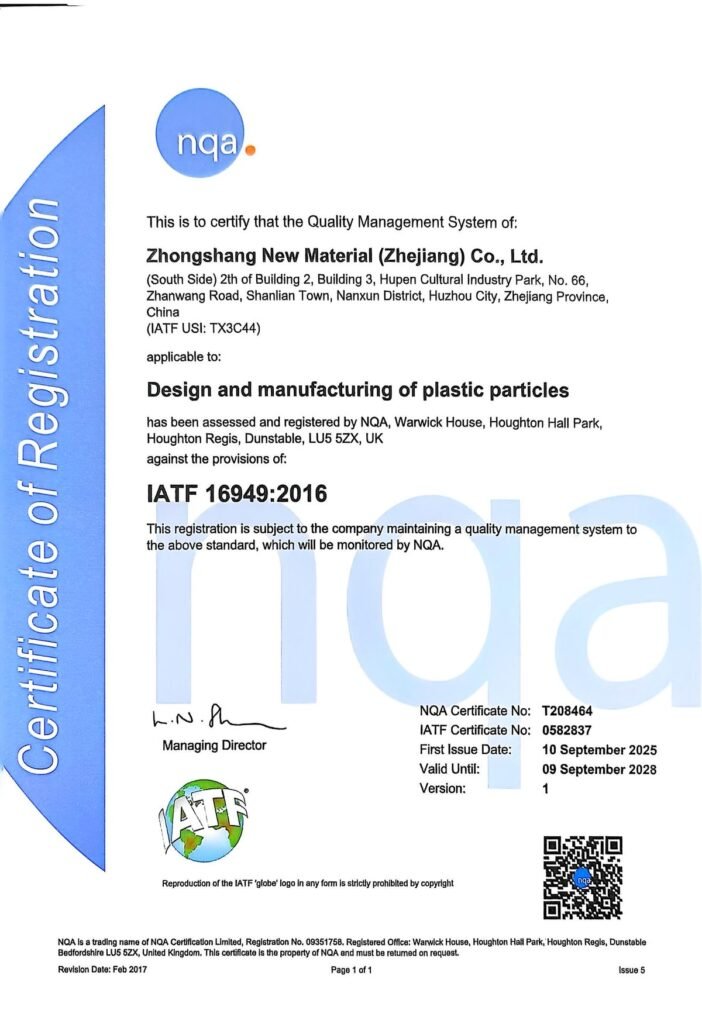
Zhongshang New Materials Certified to IATF 16949 for the Design and Manufacture of Plastic Pellets
October 21, 2025Zhongshang New Materials has been certified to IATF 16949 for the design and manufacture of plastic pellets.
About the Certification
IATF 16949:2016 is based on ISO 9001 and incorporates automotive industry requirements. It is fully consistent with the ISO 9000 standards, with a stronger emphasis on defect prevention and on reducing quality variation and waste in the automotive parts supply chain.
The aim of the standard is to develop a quality management system that supports continual improvement, emphasizes defect prevention, and reduces variation and waste in the automotive supply chain. The standard has a clearly defined industry focus and scope of application.
It applies to manufacturing sites producing customer-specified production parts and/or service parts, and to organizations throughout the automotive supply chain. It has become a single, globally shared baseline for quality management systems in the automotive industry.
Material Categories and Applications
1. Polypropylene (PP) and Modified PP Compounds
-
Characteristics: low cost, low density, good chemical resistance and ease of processing.
-
Main modification approaches: impact-modified PP incorporates elastomers, such as EPDM, to improve impact resistance for bumpers, instrument panels and interior door panels. Filled PP incorporates talc, glass fiber or other fillers to improve stiffness, heat resistance and dimensional stability for door panels, fan shrouds and air-conditioning components. Low-VOC PP is used for components with demanding in-vehicle air-quality requirements, such as interior parts.
-
Typical applications: bumpers, instrument panels, door panels, air-conditioning system components and battery cases.
2. Polyamide (PA or Nylon)
PA6 and PA66 are particularly important engineering plastics. Their characteristics include excellent mechanical strength, wear resistance, heat resistance and oil resistance.
-
Main modification approaches: glass-fiber reinforcement greatly improves strength and stiffness and is the most widely used modification method. High-temperature PA is used in hot environments, such as under-the-hood applications. Impact-modified PA improves impact performance at low temperatures.
-
Typical applications: engine covers, intake manifolds, cooling fans, power-window regulators, connectors and fuel-tank caps.
3. Acrylonitrile Butadiene Styrene (ABS)
-
Characteristics: high surface gloss, high hardness, scratch resistance and suitability for electroplating.
-
Main modification approaches: heat-resistant ABS improves heat deflection temperature. Electroplating-grade ABS provides a metallic surface finish.
-
Typical applications: instrument-panel bezels, grilles, door handles, decorative trim and interior switch buttons.
4. Polycarbonate (PC) and PC Blends
-
Characteristics: very high impact strength, good transparency, heat resistance and flame retardancy.
-
Main modification approaches: PC/ABS blends combine the heat and impact resistance of PC with the processability of ABS and are among the most commonly used polymer blends in automotive interiors. Glass-fiber-reinforced PC provides increased stiffness.
-
Typical applications: instrument panels, rear combination-lamp lenses, interior and exterior parts, and automotive glazing.
5. Polybutylene Terephthalate (PBT)
-
Characteristics: excellent chemical resistance and electrical insulation, low moisture absorption and good surface gloss.
-
Main modification approach: glass-fiber reinforcement improves strength and heat resistance.
-
Typical applications: lamp holders, sensor housings, ignition coils, fuse boxes and connectors.
6. Polyoxymethylene (POM)
-
Characteristics: known in China as a steel-replacement plastic, POM offers very high stiffness, strength and wear resistance, together with a low coefficient of friction.
-
Typical applications: fuel-system components, such as fuel-tank caps and fuel-pump units, door-lock systems, seat-belt buckles and fuel-injector nozzles.
7. Polyphenylene Ether (PPO/PPE) and Its Blends
-
Characteristics: excellent dimensional stability, hydrolysis resistance and electrical insulation, with very low water absorption.
-
Main modification approaches: PPO/PS or PPO/PA blends improve processability while balancing other properties.
-
Typical applications: wheel covers, instrument-panel frames, high-voltage charging interfaces and fuse boxes.
Zhongshang New Materials (Zhejiang) Co., Ltd. focuses on the research, development, production and sale of modified plastics. Our materials are widely used in automotive lightweighting and in the battery, motor and electronic-control systems of new energy vehicles, helping customers reduce costs and improve efficiency.